Wait Times in the ER Aren't Random: Inside the System That Decides Who Is Seen First
Few waiting rooms test a person's patience quite like an emergency department. You arrived with a broken wrist, yet the man who walked in after you has already been taken back. Someone else has been waiting three hours with abdominal pain. It can feel arbitrary, even unfair. In reality, nothing about emergency room sequencing is random. It follows a clinical framework that most patients never hear explained — and understanding it can genuinely change your experience.
The Five-Level Scale Behind the Curtain
Nearly every American emergency department sorts arriving patients using a five-tier acuity scale, most commonly the Emergency Severity Index (ESI). Level 1 is reserved for patients in immediate danger of losing life or limb — cardiac arrest, major trauma, unresponsiveness. These cases are roomed before registration is even complete.
Level 2 covers high-risk situations: chest pain that could be cardiac, stroke symptoms, severe shortness of breath, an infant with a dangerously high fever. These patients are typically seen within minutes.
Levels 3 through 5 form the spectrum of urgency. A Level 3 patient might need multiple diagnostic tests but is stable — think of a moderate kidney stone or a deep laceration. Levels 4 and 5 are the sprained ankles, mild rashes, and prescription refills that, while uncomfortable, can safely wait while resources go to those who cannot.
A brief but important point: the triage nurse is not judging whether your pain is "bad enough." They are estimating how quickly your condition could deteriorate. That distinction explains much of what looks like inconsistency from the waiting room.
What Triage Staff Are Actually Measuring
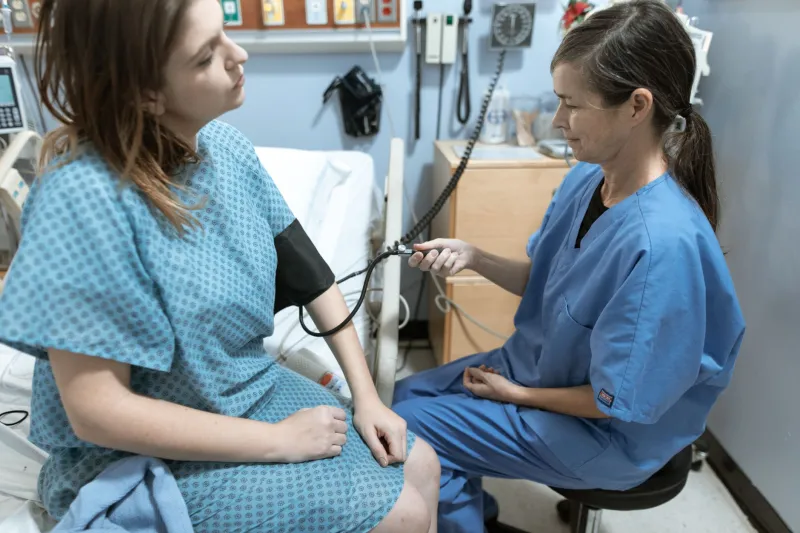
Within moments of your arrival, a triage nurse collects a surprisingly dense packet of information:
- Vital signs. Heart rate, blood pressure, respiratory rate, temperature, and oxygen saturation. Abnormal values are the fastest route to a higher acuity level.
- Pain level and location. Especially pain in the chest, head, or abdomen, which triggers protocol-driven workups.
- Onset story. "Sudden" and "worst ever" are clinically meaningful words that change how quickly you are evaluated.
- Risk factors. Age, pregnancy, diabetes, immune suppression, recent surgery, and blood-thinning medications all raise concern levels.
This is also why the waiting room order keeps shifting. A patient who was stable at intake can be reassessed and moved up if their vitals change. Meanwhile, someone who looked comfortable an hour ago may quietly be awaiting imaging results rather than being forgotten.
What You Can Do: Communicate Like a Clinician
You cannot — and should not — attempt to game the system. But you can make sure the triage nurse has the information they need, quickly and accurately. That alone protects you.
Lead with the symptom, not the story. "Chest pressure that started two hours ago while I was walking" is more useful at triage than a ten-minute narrative. Details matter; save them for the treatment room.
State the dangerous words when they are true. Sudden onset. Worst headache of my life. I fainted. I'm on blood thinners. I'm pregnant. I had surgery last month. These phrases are triage triggers, and omitting them out of politeness works against you.
Bring a current medication list. Even a photographed pill bottle lineup on your phone gives the team critical context in seconds.
Know when to return to the desk. If your condition worsens while you wait — new numbness, spreading pain, vomiting, confusion — tell the triage staff immediately. That is not complaining; it is new clinical data.
What Doesn't Help
Raising your voice, arriving by ambulance for a non-emergency, or exaggerating symptoms tends to slow the department down for everyone, including you. Ambulance arrivals for minor complaints still occupy crews and beds. And a triage note that doesn't match your presentation simply gets reconciled later, costing the team time it could be spending on care.
If you have waited a long time and want an update, you are entitled to ask politely: "Can someone check on my status or let me know if anything has changed?" That is a reasonable request, and staff can generally answer it.
A Word on Fairness
Hospitals continuously work to keep triage equitable, and studies show that objective vital-sign-based systems reduce bias in waiting room prioritization. Still, if you believe you or a loved one is deteriorating and being overlooked, say so directly and calmly to the charge nurse. Advocacy on behalf of a patient is never unwelcome — it is often how critical details surface.
The Bottom Line
The emergency department is not a first-come, first-served queue; it is a continuous sorting operation designed to keep the sickest patients safest. You cannot control the order around you, but you can control the quality of the information you give at triage. Clear, specific, honest communication is the single most powerful tool a patient or family member carries into any emergency room — and it costs nothing to use it.